
Begin a robotics pilot with one clearly defined task
A robot demonstration can make a task look effortless. A working application must also cope with the actual parts, surrounding equipment and people involved. Before choosing hardware, describe one task closely enough that a qualified integrator can assess its feasibility and risks.
Observe the task in its real setting
Choose a specific operation rather than a broad ambition to automate the workshop. Record what enters the step, how it is positioned and what should leave it. Include the ordinary variation in parts or packaging rather than showing only the easiest example.
Ask the people doing the work where they adjust, inspect or intervene. These less visible actions often explain why a demonstration does not represent the complete task. Record them as requirements for assessment, not as problems a robot will somehow solve later.
Define the surroundings
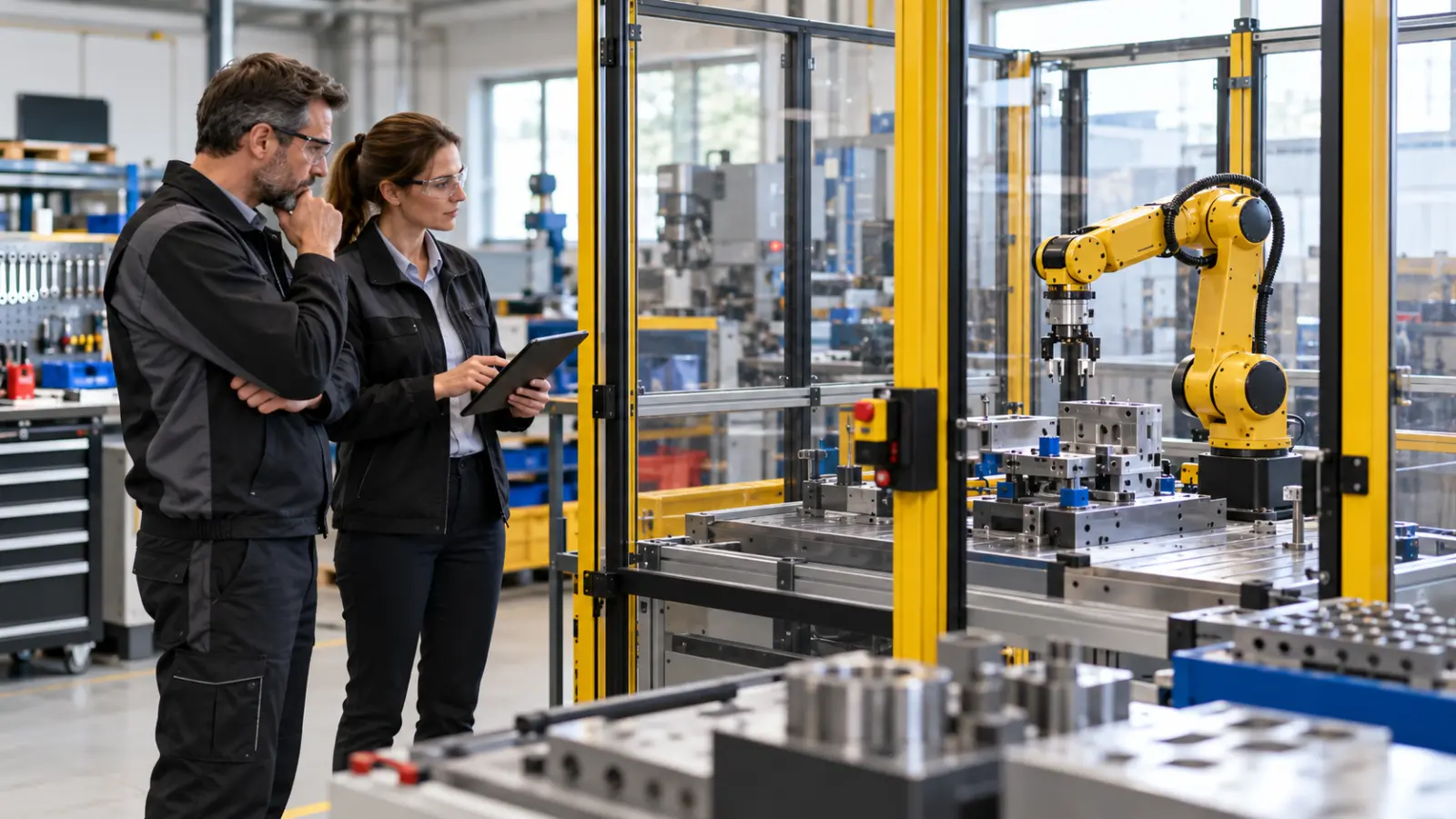
Describe the space, nearby work and how materials are supplied and removed. A robot arm is part of a system that may also include gripping, sensing and other equipment. Ask the integrator to consider the complete application rather than treating one component as the whole solution.
OSHA's technical guidance addresses risks across robot-system activities. Installation, programming, cleaning and maintenance deserve attention as well as normal production. The label collaborative does not remove the need for an application-specific professional safety assessment.
Set a bounded pilot question
An illustrative question is whether a defined range of parts can be presented, handled and placed consistently under agreed conditions. Decide what will be observed and which situations are outside the trial. Avoid turning a small test into a promise about the whole production line.
Include time for changeovers, rejected parts and staff training in the discussion. A fast movement is not the same as a useful working process. Ask what happens when a part is missing or incorrectly positioned.
Decide before expanding
Review the pilot with the people responsible for production, maintenance and safety. Record what worked, what required intervention and what remains unresolved. Do not put an unassessed trial into routine use merely because the demonstration was promising.
A worthwhile first robotics project produces a clearer understanding of the task and its limits. That evidence helps you decide whether to improve the setup, investigate another approach or continue with the existing process.
Sources: Occupational Safety and Health Administration: Technical Manual, Industrial Robot Systems and Industrial Robot System Safety.