
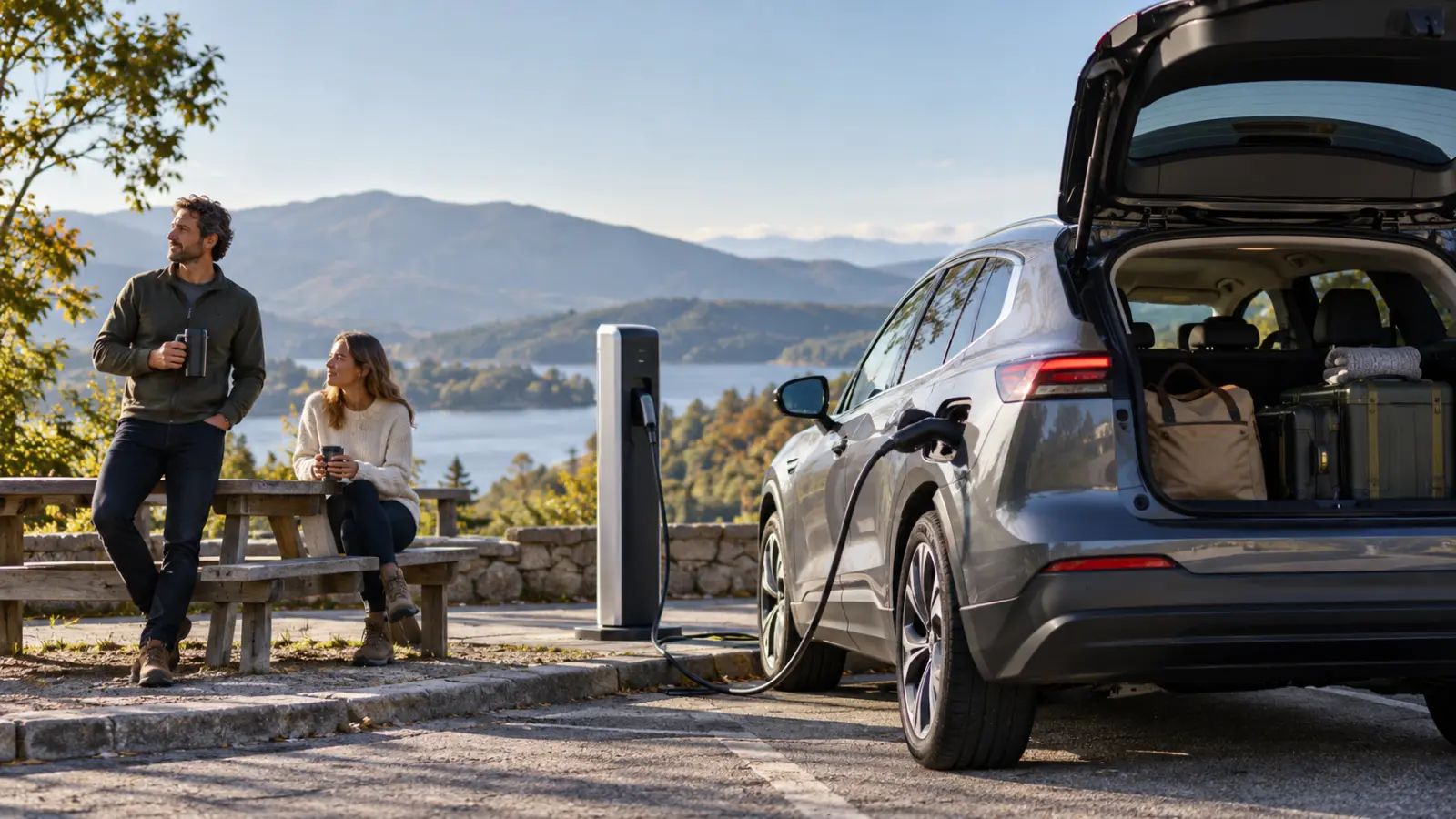
Plan an electric-car trip with useful alternatives
A longer electric-car journey works better as a sequence of manageable stages than as a single range calculation. Plan where charging fits into the trip, what you need to access each stop and what you will do if the first choice is unavailable. The result should support your decisions while driving, not lock you into a fragile timetable.
Give the planner realistic starting information
Use your actual vehicle and battery setting, not a similar model selected for convenience. Enter the expected departure charge and a sensible arrival reserve. IONITY's route-planner guidance identifies vehicle settings and weather among planning inputs. Check what your chosen planner considers and what you still need to assess separately.
Include luggage, any roof equipment or trailer, and relevant manufacturer guidance in your own preparation. Do not take the advertised range as a promise for every route. Review the plan after a material change to the journey rather than preserving an estimate that no longer describes it.
Assess the stop as a place
For each proposed charging location, check vehicle compatibility, access hours and how you will start and pay for a session. Look at the actual entrance and direction of travel. A charger near the motorway on a map may require a detour that matters to your plan.
Discuss passengers' needs too. Toilets, food, accessible paths and a place for a short break may affect which stop works best. If a stop depends on facilities being open, confirm that information instead of inferring it from a photograph.
Prepare a backup before it becomes urgent
Choose an alternative charging location for each critical stage. It should be reachable within your planned reserve and compatible with the vehicle. The aim is not to record every charger along the route, but to avoid making the first backup decision with almost no energy remaining.
- Is the payment method set up and usable?
- Do you have the required cable or equipment?
- Can you find support details without searching while driving?
- Have you checked destination charging rather than assumed it?
For accommodation charging, confirm practical arrangements directly: availability, access, booking, fees and any limits on use. A general facility label does not answer those questions.
Reassess during the journey
Check actual consumption and charging status when safely stopped. If conditions differ from the plan, adapt early. Leave time for waiting, breaks and the final approach rather than promising an exact arrival based only on driving time. Keep a short note after the trip of stops that worked and information you were missing. That turns the first long journey into a better basis for the next one.
Sources: IONITY: IONITY Route Planner.